Dubai was long synonymous with "living tax-free, working internationally, scaling growth". However, since the United Arab Emirates introduced standard corporate taxation, the picture has become more nuanced: tax optimisation hasn’t "gone away", but it’s certainly no longer the straightforward zero-tax narrative of the past.
Precisely for that reason, classic zero-tax locations are coming back into sharper focus. One of the best-known and, at the same time, most reputable candidates is the Cayman Islands: a British Overseas Territory in the Caribbean, with a premium image, a strong financial ecosystem and a tax system whose clarity is extremely attractive for entrepreneurs.
But: "0% tax" doesn’t automatically mean "0% effort", and Cayman isn’t a match for everyone. This article shows you when Cayman genuinely makes sense as a Dubai alternative, what typical set-ups look like, and which mistakes can end up costing you dearly.
First things first: the Cayman Islands levy no direct taxes such as income tax or corporation tax. This is also clearly described by the authorities; government revenue is generated instead through fees, duties and similar charges.
For entrepreneurs, this is particularly interesting in three scenarios:
High, international income (e.g. SaaS, online services, consultancy, agencies, IP-adjacent business models)
Investment/trading-oriented structures (with proper compliance and a bankable set-up)
Wealthy founders who want to combine tax freedom, legal certainty and a premium lifestyle
What makes Cayman special: it’s not "cheap" or "relaxed"—quite the opposite. Cayman is premium, professional and compliant. That may feel like a downside to some, but it’s exactly why Cayman works as a location in the long run.
A major difference compared with many other offshore options: Cayman is a British Overseas Territory. For entrepreneurs, that brings an environment that often feels more familiar than exotic jurisdictions: common-law logic, professional service providers, established standards and clear processes.
Especially if you value stability, reputation and predictable conditions, this is a significant advantage—and one of the reasons Cayman is internationally regarded as a reputable offshore financial centre.
Historically, one of the biggest hurdles in Cayman was this: residency and work permits are not automatically "easy", particularly if you don’t simply want to immigrate as an employee.
This is where Cayman Enterprise City (CEC) comes in—a special zone designed specifically to attract businesses. In practice, it’s relevant because it makes processes around business relocation and employment more structured and often faster. Cayman itself describes the CEC as a measure to support economic development and enhance the jurisdiction’s attractiveness.
Important: you shouldn’t see Cayman merely as a "zero-tax place", but as a complete package that only becomes practically workable for entrepreneurs through such zones in the first place.
Dubai remains strong: infrastructure, flight connections, a big-city vibe, an international talent pool, networks and events. From a tax perspective, though, it’s less "simple" today, because corporate-tax logic and international minimum-tax mechanisms can come into play—depending on your company’s size and structure.
Cayman, by contrast, is:
radically clear on tax (no direct taxes)
significantly more expensive day to day
smaller and more "island-like" (not everyone loves that)
professionally regulated, with a focus on compliance (which strongly affects banking and substance requirements)
In short: Dubai is often lifestyle + business hub. Cayman is often zero tax + legal certainty + premium offshore—but with a higher barrier to entry.
Cayman is rarely a "starter plan". It’s particularly well suited if several of these points apply:
You run a highly profitable business or have very high investment returns.
Your business model is internationally scalable, not "Germany-first".
You can and want to demonstrate substance and real presence plausibly.
You want an environment with reputation (banking, service providers, stability).
You accept that Cayman is more "premium island" than "metropolis".
If, on the other hand, you primarily serve customers in Germany, sign contracts there, have your team and operations there and only want to use Cayman as a "registered seat", you typically run into the classic risks: permanent establishment, place of effective management and residency questions.
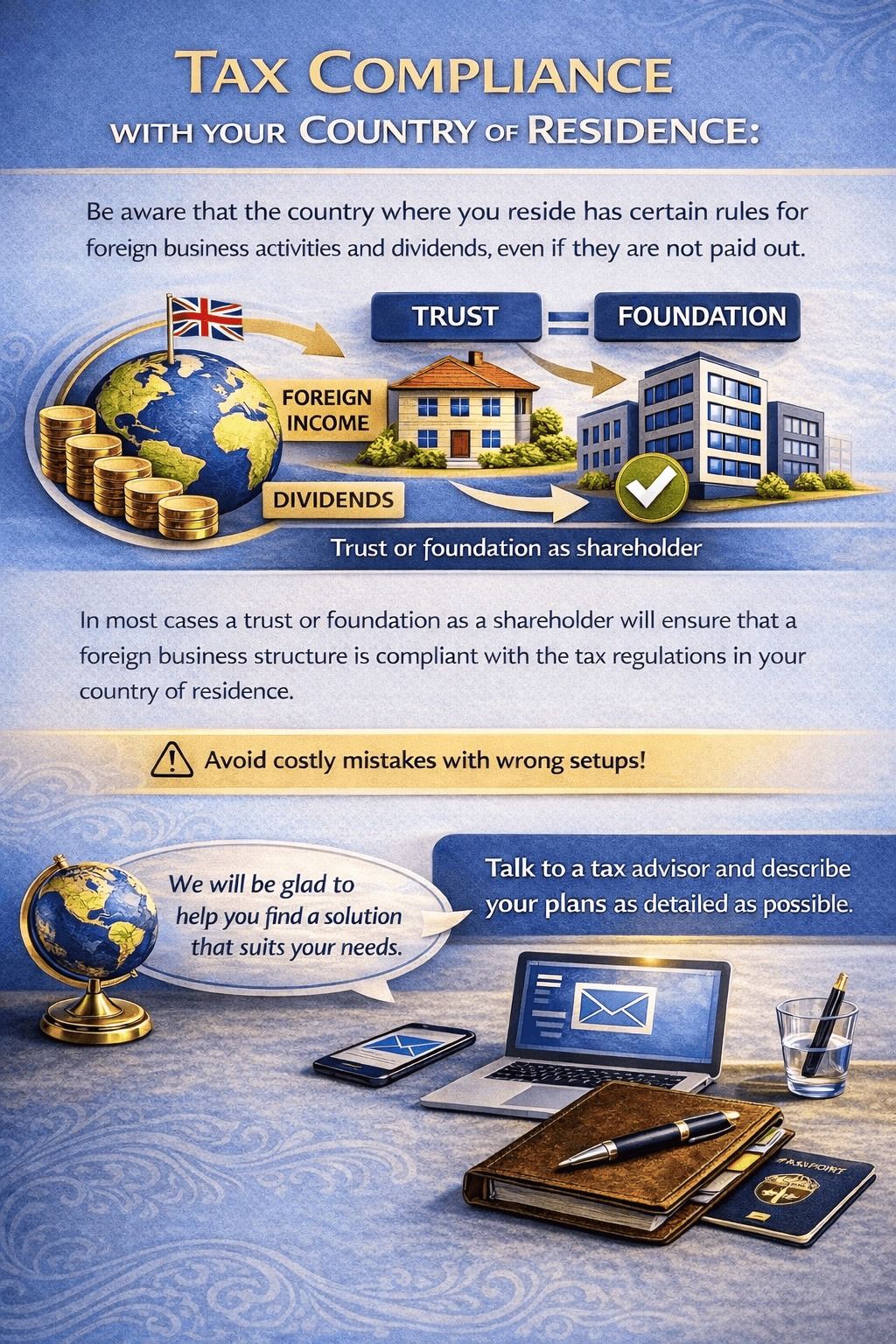
Cayman can be 0% locally. But that doesn’t mean your home country automatically stops mattering.
For German-speaking entrepreneurs, the following are typically relevant:
Do you retain a place of residence / habitual abode?
Where is your centre of vital interests?
Where are decisions actually made, signed and managed?
Is there a permanent establishment in your home country?
Do you still have income from your home country (e.g. property, shareholdings)?
If you want to use Cayman seriously as an alternative to Dubai, the key point is: it has to be a real move / a real shift in your life and business reality. Anything else isn’t tax saving—it’s just an expensive construct.
Cayman has a reputation for being "tax-free, but clean". That is exactly why Cayman is not a place where you can simply get waved through with minimal substance.
In reality, that means: depending on what you do, you need a set-up that is understandable and defensible:
a clear corporate structure
clean banking and payment flows
documented decision-making processes
traceable roles (directors, management, and where applicable local service providers)
compliance-ready documentation (KYC/AML, beneficial owners, source of funds)
That sounds like bureaucracy—but it’s exactly why Cayman is seen internationally as more of a "premium" jurisdiction.
Many people massively underestimate Cayman in one respect: the cost of living and ongoing fees. Because Cayman does not fund itself through income tax or corporation tax, revenues are generated, among other things, through fees and import duties.
That means:
Housing is expensive (especially in good locations).
Imported products are expensive (on islands, that’s practically the norm).
Professional services (legal, corporate, banking, compliance) are priced at a premium.
For some, that’s a deal-breaker. For others, it’s perfectly fine—because the tax freedom and legally robust environment more than offset the extra costs.
SaaS / software / online service providers:
High margins, international market, digital delivery. Cayman can be a strong building block here, provided the entrepreneur genuinely implements the relocation and documents substance properly.
Investment/asset-adjacent entrepreneurs:
Cayman is traditionally strong in the financial ecosystem. That helps with professional set-ups—but it also requires you to take compliance and banking seriously.
Crypto-adjacent entrepreneurs:
Cayman is often mentioned in the crypto context. What matters isn’t marketing, but: a bankable structure, clean proof of origin, clear governance and a realistic presence model. Anyone who wants "anonymous and fast" is in the wrong place here.
The Cayman Islands can be an extremely strong alternative if you are genuinely looking for a set-up that combines tax freedom, British-influenced stability and a professional environment. Cayman itself clearly states that no direct taxes are levied and that revenues are generated via fees/duties etc.
If, however, you see Cayman only as an "address trick", you’ll end up burning money rather than saving it. Cayman’s strength isn’t that it’s "easy"—it’s that it works when done properly: substance, presence, compliance, and a real relocation of both life and business.