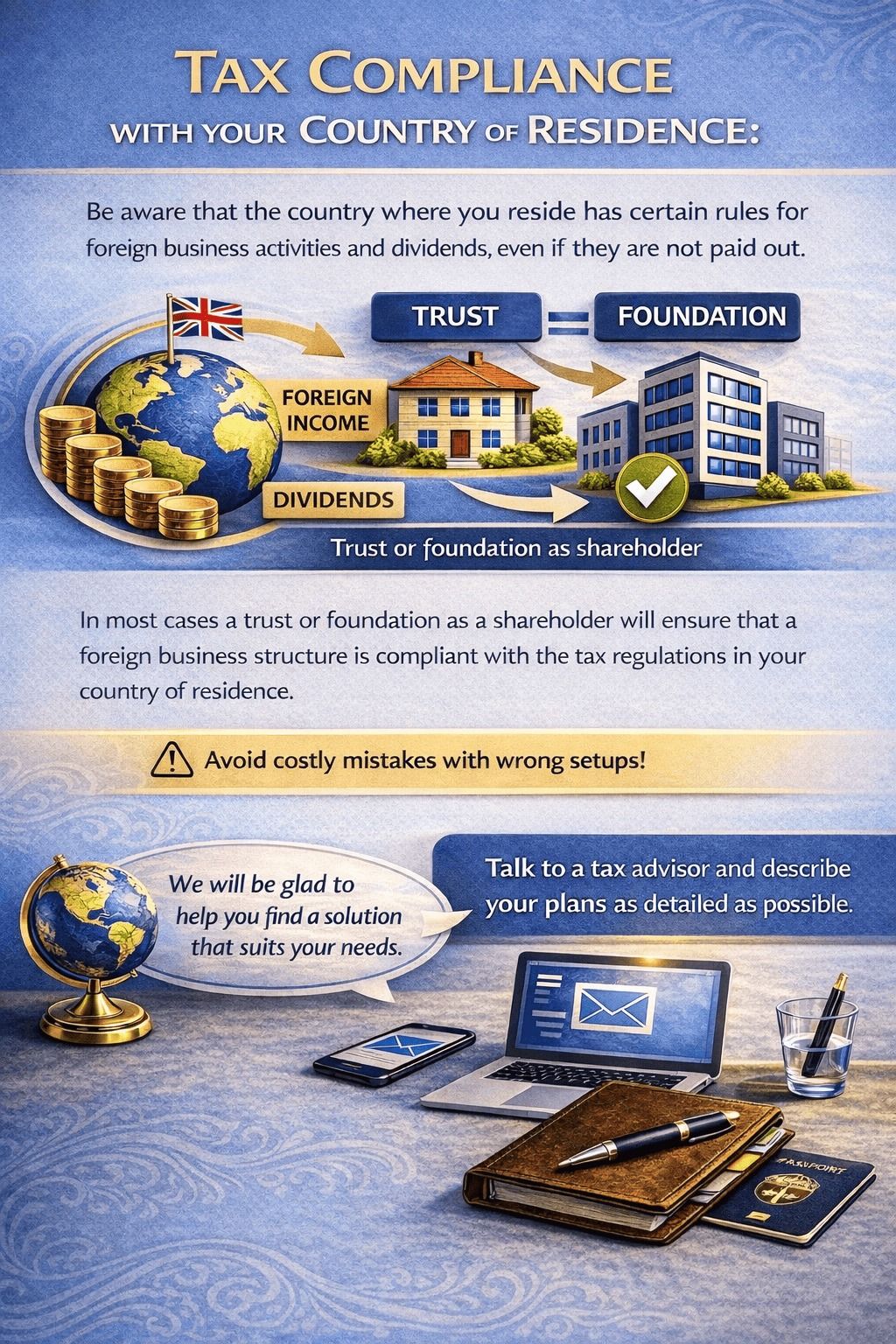
German entrepreneurs facing high tax burdens are increasingly looking for ways to shield their wealth from the German exit tax under section 6 AStG. Singapore, as a territorial tax haven, offers ideal opportunities here. An overseas foundation or trust allows the lawful transfer of GmbH shares before the deemed disposal taxation applies. This guide shows, step by step, how heavily taxed self-employed individuals can successfully move into Singapore’s low-tax system, including calculation examples and risks.
Exit taxation under section 6(1) AStG affects individuals with significant holdings in corporations as soon as they permanently move their residence abroad. It triggers a deemed disposal: hidden reserves in GmbH shares, AG shares or comparable interests are taxed at market value as if you had sold everything. Tax rates of up to 45% plus solidarity surcharge apply. The prerequisite is unlimited tax liability in 7 of the last 12 years before leaving.
Pure property holdings or operating permanent establishments are not affected, but typical entrepreneur assets such as GmbH shares (from a 1% holding) fall fully within scope. For moves to EU/EEA countries, an interest-free deferral until the actual sale is possible. However, if you move to a third country such as Singapore, everything becomes due immediately.
Example: An entrepreneur with €2m of hidden reserves pays up to €900,000 in tax—cash that is then missing to start anew.
Singapore taxes on a purely territorial basis: only income earned in Singapore or remitted there is subject to income tax (0–22% progressive, often effectively under 15% for expats). There is no capital gains tax, inheritance tax or wealth tax, which is particularly advantageous for entrepreneurs with international income. Corporate tax is 17%, with reliefs for start-ups down to 0% on the first SGD 100,000 of profit.
The Germany–Singapore double taxation agreement (DTA) prevents double taxation and helps protect against exit-tax consequences on remittances. Many Germans use the Employment Pass (EP) for skilled workers from SGD 5,000 monthly income, or set up a Pte Ltd (Private Limited). Company formation is possible within 1 to 2 days. Living costs in Singapore are high; to rent centrally, you should budget around SGD 4,000–6,000 per month. In return, entrepreneurs can save net hundreds of thousands each year compared with Germany.
Type of tax | Germany | Singapore |
Income tax | 45% + solidarity surcharge | 0–22% territorial |
Capital gains | 25% flat tax + exit tax | 0% |
Corporation tax | 15–30% | 17% (reliefs) |
Inheritance/wealth | Up to 50% / 1% | 0% |
A Singapore private foundation or trust protects your assets effectively by transferring assets such as GmbH shares there before you leave. This means nothing taxable remains in your personal estate, and the exit tax under section 6 AStG no longer applies. Singapore offers flexible trusts under the Trustees Act, which require no minimum capital, are tax-free on capital gains, and—through a local trustee such as a bank or solicitor—provide a high degree of anonymity.
The benefits of a Singapore private foundation or trust include secure succession planning for family provision, effective creditor protection and tax neutrality. For private trusts, ACRA registration is optional. German tax offices scrutinise structures closely for “transparency”. Avoid, therefore, extensive settlor control to sidestep transparency issues. A common structure is for the foundation to hold the GmbH shares while you, as beneficiary, receive tax-efficient distributions.
Have hidden reserves valued (valuation report for a GmbH: market value minus book value). Draft the foundation statutes with objectives such as asset management and family protection. This can be done tax-free as a gift.
Timeframe: 3–6 months before departure to avoid allegations of arbitrary structuring.
Choose a licensed trustee, for example DBS Bank or a specialist law firm. Then transfer the assets such as shareholdings or portfolios into the trust. Costs are around SGD 5,000 to 20,000 for set-up and SGD 2,000 to 5,000 per year for administration. After the transfer, you no longer hold any direct shares personally.
Deregister your residence in Germany officially, as there is a notification obligation to the tax office. In parallel, apply for the Employment Pass or the EntrePass for entrepreneurs with an innovative business plan. Approval typically takes 3 to 8 weeks. Optionally, you can then establish the company presence via a Pte Ltd afterwards.
Remit your income in a targeted, controlled manner to make the most of tax advantages. Use the double taxation agreement (DTA) between Germany and Singapore to minimise or avoid any residual taxation in Germany. Regular trustee reports also ensure full compliance with all legal requirements.
Illustrative calculation: GmbH valued at €3m, €1.5m hidden reserves.
Without a foundation: €675,000 exit tax (45%).
With a foundation: €0, as no shares are held privately.
Annual SG tax on new profits: <100,000 SGD at 17%.
Excessive control over the foundation, for example via the ability to revoke at any time, makes the entire structure “transparent”. In that case, the full exit tax under section 6 AStG may be triggered. The double taxation agreement (DTA) with Singapore does protect against double taxation, but not against the initial taxation in Germany. German tax offices closely examine whether the move is genuine, which is why a minimum stay of 183 days in Singapore must be evidenced.
Among lawful alternatives are moving to an EU country such as Cyprus with an interest-free deferral of the exit tax, transferring shares into a holding company, or staged sales before leaving to realise hidden reserves gradually. Every strategy requires an individual review by specialists to avoid legal pitfalls.
Risk | Avoidance |
Transparency | Independent trustee |
Liquidity shortfall | Advance distributions |
Visa rejection | Proof of income > SGD 5,000 |
Disclaimer: This article provides general information and is not individual tax or legal advice. Specific structures should always be agreed with a tax adviser or a specialist solicitor for international tax law.
With a Singapore foundation, highly taxed German entrepreneurs can lawfully avoid the exit tax under section 6 AStG entirely and switch smoothly into Singapore’s efficient low-tax system, including 0% tax on foreign profits. The year 2026 offers an ideal moment for this step, as current rules provide stable conditions.
Minimising exit tax requires early, strategic planning with a lead time of 12–18 months. Our specialists in international tax law analyse your individual asset structure, develop a legally robust Singapore exit strategy including a foundation structure, and support you in liaising with the tax office.
Secure a free initial consultation
Singapore has no classic exit tax like in Germany or the United States. Foreign self-employed people or expats only need to settle outstanding taxes (e.g. on salary or ESOPs) when closing a business or leaving, but there is no deemed disposal tax on assets or hidden reserves.
When leaving Singapore, tourists can reclaim GST (value added tax, 9%) on purchases (from SGD 100) via eTRS kiosks at the airport, provided the goods are exported and were bought within 2 months. For expats there is no general refund of income tax. Any outstanding taxes must be settled via IR21 before departure.
Yes, Singapore is considered a tax haven due to territorial taxation (only SG income that is remitted is taxable), low rates (17% corporation tax, 0% capital gains), tax exemptions and a dense DTA network. It appears on international tax-haven lists and attracts wealthy expats, despite stricter remittance rules since 2024.