Setting up a company abroad opens up opportunities, but it is riddled with legal and tax pitfalls. Many entrepreneurs fail because of avoidable mistakes. Here are the five most common ones and how to avoid them.
1. Mistake: Choosing the wrong jurisdiction
Choosing the location is a strategic long-term decision. A fatal misconception is to focus on superficially attractive corporate tax rates.
The risk: If you incorporate in Hong Kong, for example, this can be disadvantageous for German shareholders. The German tax authorities treat a Hong Kong Limited with a majority of German shareholders for tax purposes like a domestic GmbH. In addition, Hong Kong’s political future after 2047 is uncertain, as the contractually guaranteed autonomous special status of the city (“one country, two systems”) expires in that year.
The solution: Choose a location with substance, reputation and clear agreements. Singapore, for instance, offers political stability and over 100 double taxation agreements (DTAs) that prevent double taxation. Always analyse your business model, target markets and your personal tax situation as a complete package.
2. Mistake: Lack of “economic substance”
International tax standards require evidence of genuine economic activity at the company’s registered location.
The risk: Without a local presence (office, staff, management), your company will be classified as a mere letterbox company. Your tax office in your country of residence can then tax all profits as if they had arisen directly to you – including back payments.
The solution: Plan for real substance from the outset. Depending on the country, this includes: a local CEO (mandatory in Singapore), a rented office, a local bank account and operational decisions being made from the incorporation location.
3. Mistake: Underestimating the banking relationship
Incorporation is the first step. Obtaining a business account is often the bigger hurdle.
The risk: In jurisdictions with a limited reputation among banks, opening an account is extremely difficult. In Hong Kong, for example, over 80% of applications at major banks are rejected, and a personal, costly trip with an uncertain outcome is often required.
The solution: Rely on a financial centre with an excellent reputation. Singapore is regarded as a “white” financial centre, which makes processes with reputable banks easier. Prepare a professional business plan, proof of source of funds and CVs. An indicative bank approval prior to incorporation is advisable.
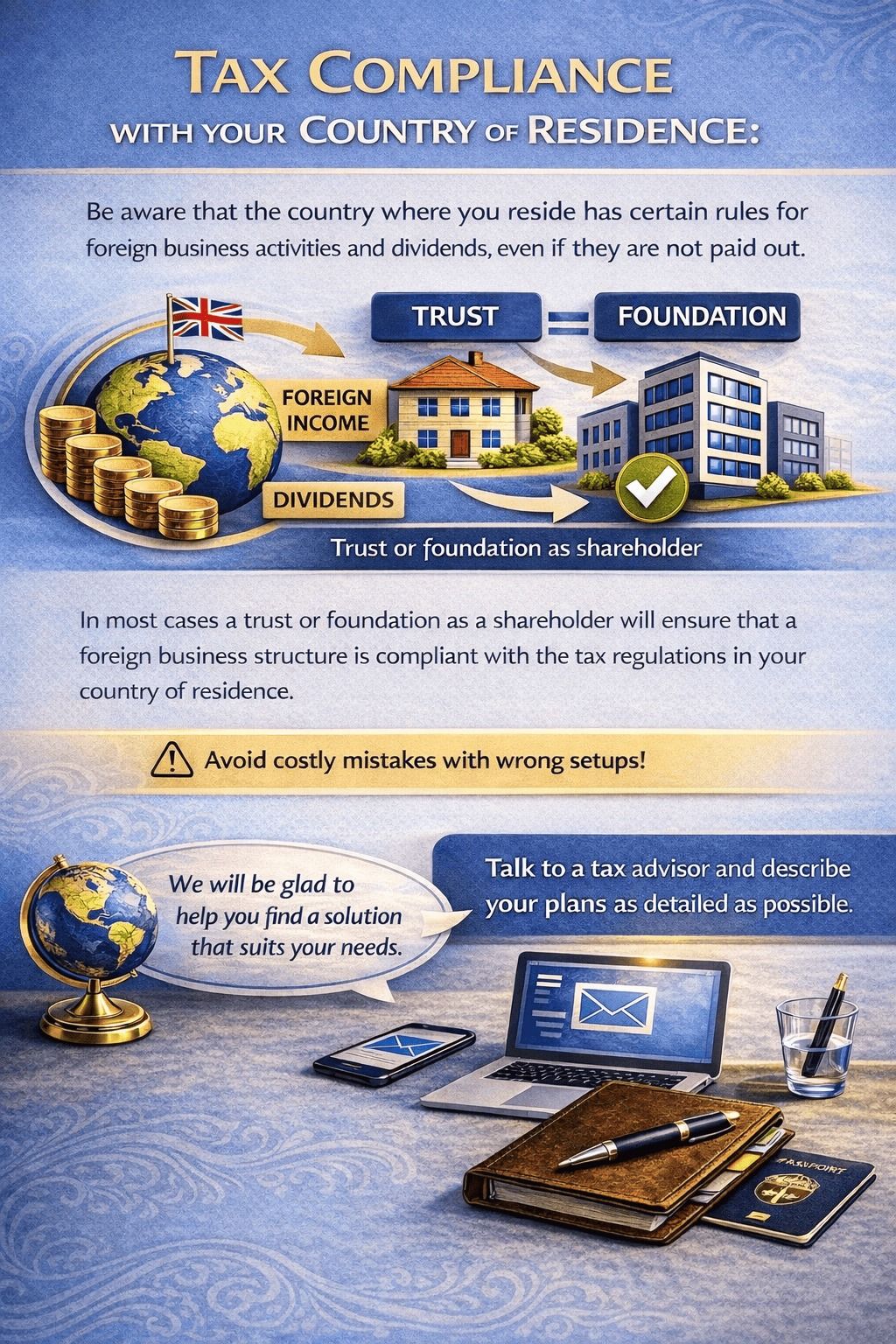
4. Mistake: Neglecting obligations in your home country
An overseas company does not освобод you of obligations in your country of residence. Ignoring them has the most serious consequences.
The risk: Failing to declare the shareholding and untaxed profits leads to severe consequences: back assessments with interest and late-payment surcharges, as well as criminal prosecution. For larger amounts, prison sentences are possible. Banks automatically report account data to the home tax authorities (AEOI).
The solution: Be completely transparent. Report the shareholding immediately (Annex AU) and seek advice from a tax adviser with international experience on how profits are to be recorded correctly (e.g. via CFC taxation). Tax evasion is not a trivial offence.
5. Mistake: An unsuitable holding structure
Whether you hold shares as a private individual or via an intermediary company is central to tax efficiency and asset protection.
The risk: If you hold shares as a natural person, dividends in Germany are subject to withholding tax on investment income (approx. 26.375%). Your private assets are also liable for obligations arising from the investment.
The solution: Consider structured solutions such as a family foundation or a trust as the shareholder. Such arrangements can protect assets and optimise taxation. The same applies here: they must be lawful and equipped with economic substance.
Conclusion: Success through structured preparation
The success of establishing a business abroad depends largely on careful planning of the legal and tax framework. What seems like a simple solution often turns out to be an expensive trap. Thorough preparation, choosing a reputable location, ensuring economic substance and absolute transparency with the authorities are non-negotiable cornerstones. Those who observe these lay the foundation for a stable and legally compliant market entry abroad.